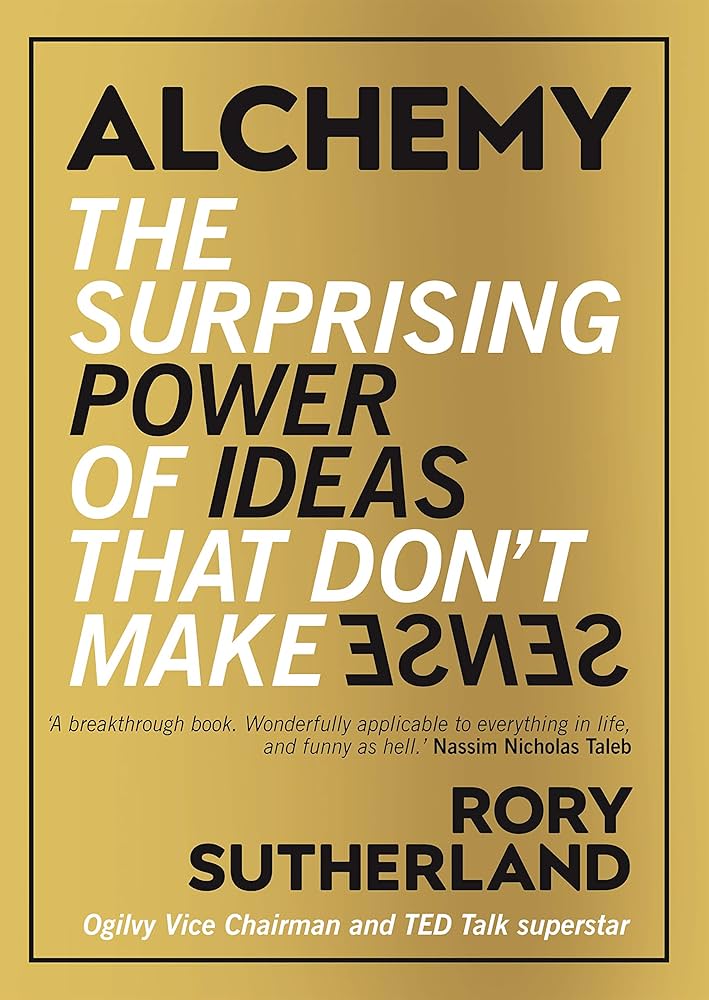
In Alchemy: The Surprising Power of Ideas That Don’t Make Sense, Rory Sutherland challenges the dominant assumption that the best decisions — in business, policy, or design — are those rooted in logic and reason. His central argument is bold yet intuitive: the most effective solutions often defy logic, because human behavior itself is rarely logical.
Drawing from psychology, behavioral economics, marketing, and evolutionary theory, Sutherland positions himself as a modern-day alchemist. Rather than seeking rigid formulas, he explores the irrational, emotional, and symbolic nature of human decision-making. The book is not a rejection of science or data, but a call to reclaim the creative, psychological, and even magical dimensions of problem-solving — the dimensions often dismissed by modern rationalism.
Logic’s Limitations and the Rise of Psycho-Logic
The book opens with a critique of the dominance of logical reasoning in business and society. According to Sutherland, most institutions — from governments to corporations — design solutions based on what is rationally explainable, often neglecting how humans actually behave.
Logic, he argues, is a useful tool but a terrible master. It filters out anything that cannot be quantified or proven in advance. Yet, some of the most successful ideas in history — whether marketing campaigns, product innovations, or social norms — succeeded not because they made logical sense, but because they felt psychologically right.
To account for this, Sutherland introduces the idea of psycho-logic — the internal, emotional logic by which people truly make decisions. Unlike rational models, psycho-logic is nonlinear, symbolic, and deeply sensitive to context. It is why people prefer certain brands, tolerate inefficiencies, and choose suboptimal options that better align with their values or emotions.
Signalling as Social and Personal Currency
A central theme in the book is the concept of signalling — the idea that much of human behavior is driven by the desire to send messages, both to others and to ourselves. People don’t just buy a product for what it does; they buy it for what it says.
In marketing terms, this explains why individuals purchase luxury watches, wear designer labels, or drive electric cars. These behaviors function as status signals, often more powerful than any functional benefit. However, Sutherland goes further by explaining that we also signal to ourselves. A person may buy a gym membership or fly business class not only to impress others, but to reinforce their own self-image. In these cases, the act becomes a form of self-persuasion — a way to shape identity through action.
Satisficing and the Myth of Optimization
Another concept Sutherland explores is satisficing, a term coined by economist Herbert Simon. Unlike optimizing — where people seek the absolute best option — satisficing means choosing what is “good enough.” It reflects how most real-world decisions are made.
Consumers don’t usually compare every possible product to find the best one. Instead, they choose the option that meets a minimum threshold of acceptability, is easy to access, and feels right emotionally. This idea undermines the prevailing business obsession with optimization. A technically superior product may lose to a psychologically satisfying one. Ease, familiarity, and confidence often outweigh measurable performance.
Perception vs. Reality: The Psychophysics of Experience
The field of psychophysics, which studies how people perceive sensory stimuli, is applied in Alchemy to show how subjective experience trumps objective metrics. Sutherland illustrates this with examples like the Eurostar train — where a massive investment was made to reduce journey time by 40 minutes, while ignoring cheaper, more impactful ways to improve the passenger experience.
The insight is that perception can be shaped more effectively than reality. A wait time can feel shorter if people have entertainment or real-time updates. A service can feel more luxurious not by improving function, but by improving aesthetics, ritual, or tone.
In this way, psychophysics reveals that people evaluate not just the outcomes, but the experience of the process. Even flawed or redundant design elements can enhance satisfaction if they feel emotionally resonant.
The Strategic Value of Redundancy, Surprise, and Charm
Sutherland challenges the modern fetish for efficiency and minimalism. In many contexts, redundancy, overdelivery, and even theatricality are more valuable than stripped-down logic.
Consider overstaffed hotels or highly stylized packaging: these features may seem inefficient or wasteful to an engineer or economist, but they contribute to emotional trust and perceived quality. People notice when things feel generous, safe, or carefully crafted.
This section of the book advocates for a return to psychological excess — adding elements that don’t “optimize” function, but improve how the experience feels. It’s not about building the fastest or cheapest product. It’s about designing something that leaves a mental and emotional imprint.
Beyond Data: The Limits of Metrics and the Power of Intuition
Sutherland also warns against over-reliance on data. When decisions are justified only by measurable outcomes, anything that cannot be quantified — like charm, humor, aesthetics, or tradition — is undervalued or eliminated.
He argues that intuition and experimentation must be protected from the tyranny of metrics. Many breakthroughs cannot be predicted in advance or defended through data. They must be discovered through creative thinking and low-cost testing. This is especially true in areas like branding, communication, and user experience, where emotional resonance matters more than raw utility.
The Alchemist’s Mindset
To be an alchemist, in Sutherland’s terms, is to develop a psychologically literate, creatively intuitive, and multidisciplinary approach to problem-solving. It means trusting your instincts, noticing patterns in human behavior, and drawing inspiration from fields outside the conventional business canon — such as anthropology, mythology, and behavioral science.
An alchemist embraces:
- Unprovable ideas, tested in the real world
- Redundancy and delight as strategic tools
- Story, symbolism, and context as central design principles
- The willingness to ask: “What would this feel like to a person, not to a machine?”
Final Reflection
At its heart, Alchemy is a book about creative freedom in a world of constraint. It argues that truly impactful ideas often begin where logic ends. By embracing the irrational, symbolic, and emotional dimensions of human behavior, decision-makers can uncover powerful — and often overlooked — paths to value.
Rory Sutherland’s message is not to abandon reason, but to complement it with magic: intuition, humor, theater, charm, and empathy. The most successful ideas are not those that are most logical — but those that are most memorable, meaningful, and human.


 gabrieltrabka.com
Leave a comment