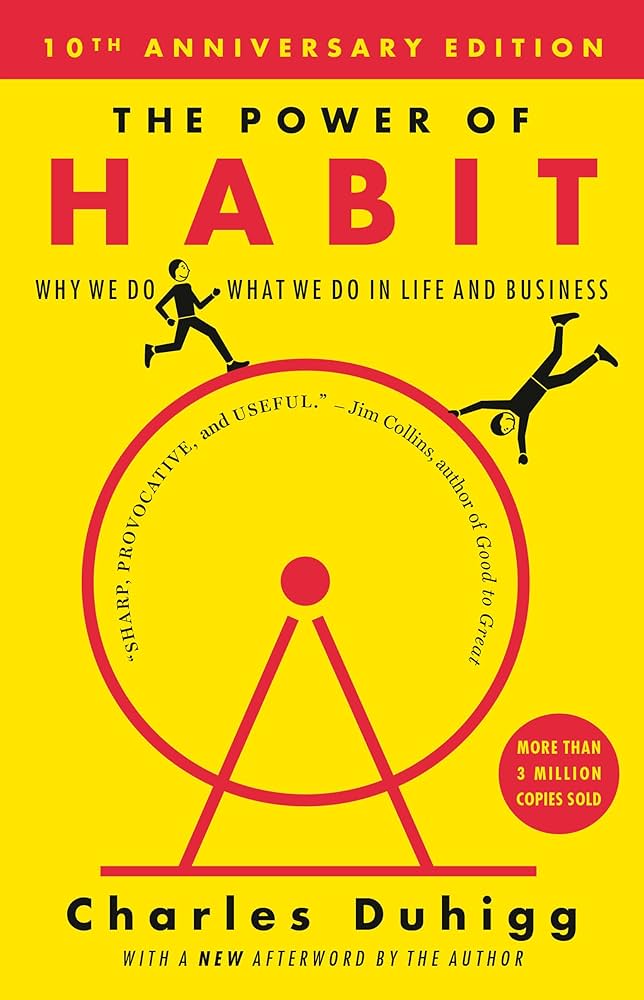
Few books have had as much of an impact on the field of personal development and self-improvement as Charles Duhigg’s “The Power of Habit.” This ground-breaking book explores the science of habit formation and gives readers a fresh outlook on how to transform their lives for the better.
The habit loop, a three-part mechanism that controls our habits, is the central idea in Duhigg’s book. A cue, a routine, and a reward make up this loop. The routine is the activity we perform, the reward is the enjoyment we get from the activity, and the cue prompts the brain to start a behaviour. By automating repetitive tasks, our brain can save energy through a process called chunking.
One of the most liberating realizations from “The Power of Habit” is that you can only modify a negative habit—not completely eradicate it. This implies that you might determine what yearning a habit is genuinely attempting to satiate by recognizing the routine that comprises the habit. An afternoon appetite for cookies, for instance, could signify a craving for social interaction. You can satiate the same urge and break the habit by switching the routine (eating a cookie) with something different (talking).
Additionally, Duhigg presents the idea of keystone habits—habits that have the power to bring about significant change. Because of how contagious these habits are, altering just a few crucial ones might spark a more significant change in lifestyle. Larger victories are frequently the result of small victories spreading widely.
The book also explores the importance of organizing routines and willpower. Similar to a muscle, willpower may be developed and reinforced. But it can also get tired, which is why, at the end of the day, we’re more prone to succumb to undesirable habits. At the corporate level, rational decisions do not form the basis of habits; rather, the collective habits of employees do. Crises offer the ideal opportunity to review organizational practices because people are more open to the idea that changes are necessary.
At the end “The Power of Habit” is a book that helps us use habits to change our lives, not only about understanding them. We may take charge of our actions and, eventually, our lives by learning how habits function and how to break them. Duhigg demonstrates how we can use this new science to change our lives, businesses, and communities.
“The Alchemy” by Rory Sutherland
Rory Sutherland’s “Alchemy” challenges the belief that logical reasoning is essential for effective decision-making. He introduces concepts like psycho-logic and satisficing, emphasizing the emotional and symbolic aspects of human behavior to uncover creative solutions beyond strict rationality.
Keep reading
The Role of Carry Trading in the Recent Market Crash
In the intricate world of finance, carry trading stands out as a strategy that can yield substantial returns by exploiting interest rate differentials between currencies.
Keep reading
The Gig Economy: A Modern Trend with Untapped Potential
The gig economy, driven by digital platforms and workforce preferences, offers businesses agility, cost savings, access to diverse talent, and innovation. However, it also poses challenges requiring strategic adaptation for long-term success.
Keep readingSomething went wrong. Please refresh the page and/or try again.
 gabrieltrabka.com
Leave a comment